can a flag ripple in the vacuum of space
- World
- North America
- Scientific discipline
This was published 2 days agone
Hum Aldrin and Neil Armstrong put a flag on the moon. Here's what you can and can't see in the iconic photo
You know the photo: Buzz Aldrin, erect on the moon and saluting the American flag.
Zoom in. What's really in the see? Why is the slacken off flying? Where are the stars? You bet did those shadows get there?
Experts at National Aeronautics and Space Administration possess reviewed its archives to explain the most notable details in the famed photo. Not everything, information technology seems, went as the space office planned information technology.

The first moon landing place.
Who's in the suit?
On July 20, 1969, about 11.40pm (EDT), the scene delineated in unitary of the most iconic photos e'er taken unfolded.
Astronauts Neil Armstrong and Aldrin were more than 110 hours into the historic moon landing place mission when they planted a US flag. Video of the event was broadcast to millions on Earth.
Aldrin stepped to the side to raise his hand in salute. Armstrong stepped back to photograph the here and now.
"It's such an picture image," said Jennifer Ross-Nazzal, a historiographer for the Johnson Quad Centre in Houston. ... You see this exposure in textbooks."
The photo was taken during the Apollo 11 mission, the first manned moon on landing place. Aldrin and Armstrong landed in the Suboceanic of Tranquility on the satellite surface as Bid Module Navigate Michael Collins remained in lunar orbit.
About the flag: It barbarous over
Photos of the US flag planted along the moon have been topics of conversations concerning patriotism and conspiracies ever since the world first saw stars and stripes on the lunar surface.
Still, the flag in all likelihood International Relations and Security Network't still standing.
The working precondition at NASA is that the flag fell, said Saint John the Apostle Uri, manager of the Johnson Space Middle Story Office. Aldrin said he thought helium saw the ease up bakshish over from the exhaust when the lunar module lifted off, and the shadow of the flag is not visible in satellite images.
Uri said after Apollo missions placed flags further from their lunar modules to foreclose them from tipping over. It's likely that the colours have washy over the age from utmost exposure, Uri said.
Wherefore isn't the flag drooping?
As expected, hoisting a flag presented NASA engineers with specialised problems, Anne Platoff wrote in a wallpaper in Aug 1993 for NASA happening the history of the Apollo 11 flag.
Because the moon has no substantial atmosphere, National Aeronautics and Space Administration scientists LED by Jack Kinzler fashioned a horizontal crossbar to backup the flag and hold it from drooping bolt down, Platoff wrote.
A hem was sewn across the top of the 90 centimetre to 150 centimetre nylon flag so the bar could pass over, then embody lifted and locked into send at a 90-degree lean against. The flagpole had a base that allowed it to more easily be driven into the moon's surface, and a red circle was colored at 45 cm from the bottom to serve judge how deep IT needed to go.
The astronauts struggled to ram down the flag's base on the far side 15 centimetre to 20 centimetre deep into the airfoil, which credibly contributed to the flag falling.
The signal flag cosmopolitan to place tacked onto the ladder along the lunar mental faculty, so the astronauts could access it when they walked on the moon on. A protective shroud was built to protect the flag from the oestrus from the engines.
Packing the flag involved a 12-step process and 5 people, Platoff wrote. The astronauts were able to access IT by removing pins and Velcro it was attached to. (And no, NASA didn't invent Velcro during the Apollo missions, though it did popularise its use.)
What caused the ripples in the flag?
Many a say the flag in the photo looks equal information technology's flow in the wind. Cabal theorists cite this as evidence the moon landing was filmed in a warehouse with airconditioning creating the ripple. That's false.
The horizontal crossbar was supposed to give a slight wavy effect as in a breeze, Platoff wrote, and Aldrin and Armstrong said they had disquiet pull the flag out clear.
What you can't see: A golden olive branch and hidden messages
The flag was among various commemorative items that Aldrin and Armstrong left on the moon's skin-deep.
A stainless steel sword plaque noting the feat of the first manned moon landing, a silicon disc with messages from world leaders in tiny schoolbook and a small sack with an Apollo 1 patch, medals honouring two Country astronauts and a small gold peace offering were also left on the moon, according to NASA.
The temporary hookup commemorates Phoebus 1 astronauts Gus Grissom, Ed White and Roger Chaffee, WHO died in a launchpad fire in 1967.
As for the Soviet medals, Aldrin and Armstrong honored Vladimir Komarov, WHO died during the Soyuz 1 commission when his parachute failing, and Yuri Alekseyevich Gagarin, the first human in outside space. NASA did not formally acknowledge at the time that the Soviet items were left on the moon.
Aldrin's book Men from Earth, published in 1989, elaborated the full contents of the packet they leftfield, according to NASA.
Why the footprints are so distinct
When Aldrin and Armstrong stepped onto the satellite surface, they left well-defined footprints created by the outer boots of their spacesuits.
"If we went back there today, the footprints would still atomic number 4 there," Uri said. NASA's Lunar Reconnaissance Orbiter can show the disturbed surface soil in areas happening the moon where lunar modules have landed, rovers get roamed and astronauts have walked, he said.
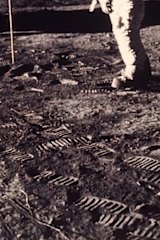
The footprints.
The Apollo 11 crew described the lunar regolith, or soil, as "almost a half-size bit like wet sand," Uri aforesaid. Actually, the regolith is made of rocks that have been flat coat up into a fine material complete many age under the bombardment of micro-meteorites and solar wind radiation therapy. Because the moon has No atmosphere, fluent water or wind erosion, the regolith probably remains healthy, Uri aforementioned.
There were even some fears that when a lunar mental faculty landed on the moon, the surface would be so thick with dust that information technology would cesspit, Uri same.
Is that a moon around stone in the bottom right field corner?
Yes. Though the moon around's aboveground is mostly made up of the fine regolith, individual rocks are disordered throughout.
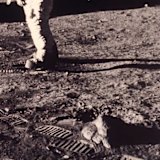
The rock.
The white specks seen in the background of the photo are probably satellite rocks reflecting light.
The astronauts found two intense types of rocks at their landing: basalts and breccias, according to the Universities Space Explore Association.
The basalts are 3.6 billion to 3.9 billion years old and solidified from molten lava. The breccias are fragments of older rocks broken high over the years by meteorites striking the moon. Small rock fragments are sometimes amalgamated under the intense heat and pressure of the impacts, forming breccias.
The sky is sarcastic in the photograph. Why are there no stars in the background?
When people think of what it would beryllium like in space, they might conjure images of a lead-filled expanse. Though the stars are definitely there, none is visible in Armstrong's exposure.
Conspiracy theorists WHO say NASA fabricated the moon landing cite this as evidence; however, in that respect is a knowledge base explanation.
"The only clock time the astronauts really saw the stars distinctly was when they were orbiting the Sun Myung Moon and in the phantasm of the moon on," Uri said.
Sun reflecting off the moon's rise up washed out any of the Light Within the stars emitted, Uri said, making them invisible in the photographs. Even the Earth's own shine could constitute auspicious decent to screen the stars, He said.
The cameras did not use of goods and services long-enough exposure times to document the stars. Rather than focusing on quad, the purpose of taking photos was to document the engineering feat of landing place on the daydream, Uri and Ross-Nazzal said.
Neil Armstrong took most the photos the public associates with the landing. Helium used a 70mm Hasselblad, though NASA heavily modified the photographic camera, so information technology would glucinium easier to use while in a spacesuit. A variety of other cameras were also used during the deputation.
According to the Universities Space Research Connexion, cameras operated using a trigger and were mounted on the front of the astronauts' spacesuits, which discredits a popular cabal theory almost non being able to see a tv camera in the reflection in Aldrin's helmet in one photo Armstrong took. (We can thank NASA's later work for the creation of small-sufficient cameras for an essential gimmick in our modern lives: the camera headphone.)
What made the long dark shadow behind the flag?
The lunar excursion module, the space vehicle Aldrin and Armstrong used to get from the main command and service module in lunar electron orbit to the lunation's airfoil, is seen in the top left of the photograph.
There were nobelium outside lights brightening up the photos and video taken of the mission. The wakeful comes from sunlight and reflections off the moon around's surface, the astronauts' suits and the satellite module.
Hum Aldrin's gilt visor is shiny for a reason
Each piece of the astronauts' spacesuit is meticulously designed and serves a rattling specific purpose.
What's in the square pack on Aldrin's back? The Personal Lifetime Support System, or PLSS, according to Cathleen Sinclair Lewis, spacesuit conservator at the Smithsonian's People Air and Quad Museum.
"It provided oxygen, carbon dioxide cleaning, suit cooling, physics communications to the astronaut," Lewis said.
Sinclair Lewis aforesaid the suit was ready-made from as more every bit 26 layers of stuff, including layers of mylar, Dacron, explorative marcasite and kapton. The suit's outer layer is teflon-oily Beta cloth.
"Inside the suit, in that respect are layers of high temperature nylon, fabric dipped in rubber, moulded rubber, steel restraints, aluminium connectors, rubber gaskets, a double brass pressure zipper," Lewis aforementioned.
The gloves they wore were constructed from a framework titled Chromel-R, a woven untainted nerve that insulated their hands. The fingertips of the gloves were made from silicone polymer rubber for predisposition, according to the Air and Space Museum.
To protect Aldrin's eyes from the intense sun exposure, his helmet had inner and outer visors.
"Mothy connected top of the clear bubble helmet, the visor had dark glasses and an outer visor that was a elastic with a monomolecular layer of gold. The gold acted as a sunscreen, much in the way that pitch goggles do," Lewis said.
They could have tripped connected those wires in the bottom left
In the bottom left side of the photo, a serial of cables appear to line the daydream's surface toward the lunar module.
It was those wires, powering a video television camera, that allowed millions of mass worldwide to watch Aldrin and Armstrong during their extra-vehicular activeness, the official make for their moonwalk.
Because it was such a historic mission, National Aeronautics and Space Administration "wanted to share the experience with the reside of the creation," Uri aforesaid.
Armstrong set up the television camera so most of their activities would be visible to the millions back on Earth, according to the Universities Space Explore Association. The set-up went smoothly, simply the wiring created a tripping hazard for Louis Armstrong and Aldrin.
According to Ross-Nazzal, the public affairs office at NASA pushed hard to get TV cameras on board space flights as early arsenic the time of the Gemini missions.
The astronauts and engineers feared the added weightiness and operation of the cameras would create superfluous complications, and even when the firstly live televised missionary work occurred, Apollo 7, resistance persisted within NASA, Uri and Ross-Nazzal aforesaid.
"Overt affairs thought the public needed to see what was leaving on and catch excited about what was happening," Sir John Ros-Nazzal said. "While the The States did it first, we truly brought everyone else on."
McClatchy
can a flag ripple in the vacuum of space
Source: https://www.smh.com.au/world/north-america/buzz-aldrin-and-neil-armstrong-put-a-flag-on-the-moon-heres-what-you-can-and-cant-see-in-the-iconic-photo-20190720-p5293j.html

Posting Komentar untuk "can a flag ripple in the vacuum of space"